

Build believable characters and unstoppable scenes

Every author has a process — but not every process has a framework
Every author develops their own process. Some outline meticulously before writing a single word. Others follow the story wherever it leads, discovering as they go. Some swear by dictation; others need the satisfying click of an old-school keyboard to get the words flowing. The approaches are as varied as the writers themselves.
But one technique has quietly taken hold across genres. It’s a decision-making framework borrowed from military strategy — and it turns out to be a remarkably powerful tool for fiction. It’s called the OODA Loop. Once you understand it, you’ll find it everywhere in the stories you love most.
Where the OODA Loop comes from
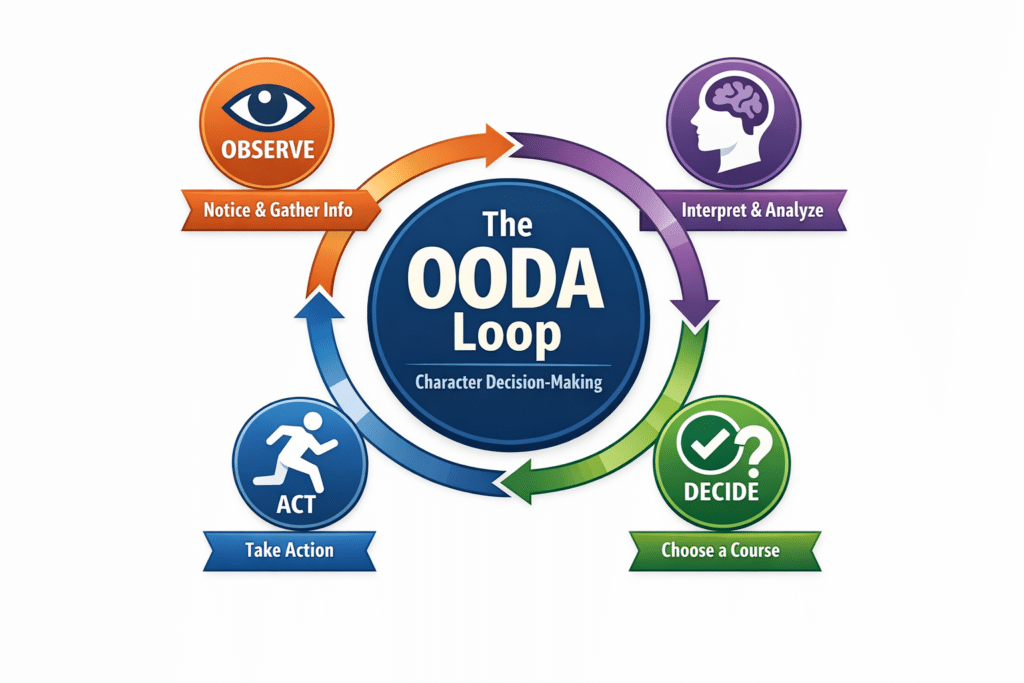
The OODA Loop was developed in the 1950s by Colonel John Boyd, a U.S. Air Force fighter pilot. Boyd studied why some pilots consistently outperformed others in combat. The answer wasn’t just skill. It was speed and clarity of decision-making. He broke that process into four stages: Observe, Orient, Decide, Act. The cycle then repeats — continuously, in real time.
What Boyd discovered about aerial combat applies equally to how people navigate any high-stakes situation — including the situations your characters face on the page. USA Today bestselling author Fiona Quinn was among the first to champion the OODA Loop as a fiction-writing tool. She holds a master’s degree in counseling and draws on backgrounds in martial arts, survival skills, and emergency management. Her co-presenter, the late Judith Lucci, brought decades of nursing experience and bestselling thriller instincts to the discussion. Together, they made a compelling case for why every fiction writer should know this framework.
Here is a one-page handout that summarizes how to use the OODA method in your fiction writing.
Editor’s note: This post was created from a previous First Draft Friday Podcast, Episode #7. View the podcast interview in full here: https://www.youtube.com/watch?v=0nVY0GtDoMA
Step one: observe — what your character notices
The loop begins with observation. Your POV character takes in the world around them — sounds, smells, textures, movement, the behavior of other people. This seems straightforward, but there’s a critical insight beneath it. Observation is never neutral; it is always selective. What your character notices is entirely determined by who they are.
A physical therapist watching a robbery suspect will zero in on the person’s uneven gait. A soldier in the same room watches the suspect’s hands, waiting for an opening. A parent scans immediately for threats to the children nearby. Same scene — three completely different observations. What your character chooses to notice, consciously or not, is one of the most efficient ways to reveal character. No telling required.
Step two: orient — where character depth lives
Orientation is the most powerful step in the loop. It’s where observation gets filtered through everything the character carries with them: their history, their beliefs, their biases, their wounds. Two people can witness the same event and come away with entirely different understandings of what just happened.
Fiona Quinn explains it this way: our brains process millions of pieces of sensory data every second, but filter out almost all of it. Your characters do the same. A character’s orientation is shaped by their age and cultural background, their education and training, past trauma, and current emotional state. This is also where conflict between characters naturally emerges. When two people orient differently to the same situation, tension follows almost automatically.
Consider three people caught in a gas station robbery. The artist in line notices the suspect’s facial structure — she could sketch him later. The physical therapist observes his limping stride and calculates he can’t run far. The soldier watches his hands, waiting for an opening to move. Three orientations from the same moment. Three completely different decisions that follow. That’s the engine of character-driven conflict.
Step three: decide — the pivot point of every scene
After observing and orienting, the character makes a choice. Sometimes that decision is deliberate and reasoned. Sometimes it’s purely reflexive — a mother’s hand shoots out to catch a falling child, faster than conscious thought. Either way, the reader needs to understand why the character chose one path over another.
Judith Lucci points out that stress dramatically affects decision-making. Fight, flight, or freeze isn’t just a phrase — it’s a physiological reality that shapes what your characters do under pressure. Tunnel vision narrows their focus. Adrenaline distorts their perception of time. A character who would make a measured choice under normal circumstances might react in ways that surprise even themselves. Those stress-driven decisions are the ones that feel most true — and reveal the most about who someone really is.
Step four: act — and start the loop again
Action closes the loop — and immediately opens a new one. When your character acts, the environment shifts around them. Something changes externally, emotionally, or relationally. If nothing changes, the scene hasn’t truly moved forward. That’s a useful diagnostic: if your scene feels static, ask whether the action at its center actually alters the situation.
After the character acts, they observe the new reality they’ve just created. They orient to it, decide, and act again. This ongoing cycle drives plot momentum. Scenes that follow the OODA Loop — even unconsciously — tend to feel alive and propulsive. Scenes that skip steps or stall between them tend to feel flat, even when the surface-level action looks busy.
Sensory writing and the power of specificity
Both Judith and Fiona emphasize the role of sensory detail in making the OODA Loop work on the page. The observation step lives or dies on specificity. “She saw him and he was a creep” tells the reader nothing. Instead, show the bile rising in the character’s throat. Describe the prickle at the back of her neck, and the way her eyes move toward the exits. Put the reader there with her.
Smell is especially powerful, Fiona notes, because it’s neurologically linked to memory. Instead of “she smelled cookies,” try: the scent of chocolate chip cookies wrapped around her like a childhood hug. That single line does something a flat description simply cannot. Sensory contrast is equally effective — you can build warmth and safety, then rip it away in a single sentence. That whiplash is where suspense lives.
Using the loop to create emotional reversals
One of the most exciting creative applications of the OODA Loop is deliberately disrupting it. Fiona offers a vivid example: a character receives flowers at work and assumes they’re from someone she’s interested in. She orients toward happiness and possibility. Then she reads the card — and discovers they’re from a stalker. Her entire orientation flips in an instant.
That emotional reversal does double duty. It reveals her hopes — and her fears. It also creates the kind of gut-punch moment readers carry with them long after finishing the book. When you control what your character observes and then subvert how they interpret it, you hold real power over the reader’s emotional experience.
The most common mistake new authors make with the loop
There’s one trap that catches nearly every new author at least once. They write how they themselves would respond — not how their character would. It seems obvious in retrospect. But when you’re deep inside a scene, it’s surprisingly easy to let your own instincts override your character’s history.
A Navy SEAL and a first-year college student observe the same threat. They orient to it completely differently. Their decisions reflect entirely different training, different fear responses, and different definitions of danger. Your character’s backstory isn’t just backstory — it actively drives every step of every scene. If a decision feels flat or unconvincing, the OODA Loop is an excellent place to start diagnosing why.
How Marlowe can help you strengthen each step
The OODA Loop is a framework you can apply manually — but technology helps you see the full picture. Marlowe, the AI-powered author dashboard from Authors AI, analyzes character motivation, scene clarity, and decision flow across your entire manuscript. It can identify scenes where a character’s decision feels unmotivated. It flags spots where pacing stalls between orientation and action, or where the loop breaks down in ways that are hard to see when you’re close to the work.
Think of Marlowe as a developmental lens you can apply before your manuscript ever reaches a human editor. The stronger your scene structure going in, the further your editor can take it. The OODA Loop and Marlowe are natural partners. One gives you the framework — the other shows you where it’s working and where it isn’t.
Start building stronger characters and scenes today
Whether you’re writing your first novel or your twentieth, the OODA Loop gives you a repeatable structure for making characters feel real. It makes scenes feel inevitable. Apply it intentionally and your readers will believe in your characters — and be unable to stop turning pages.
Observe. Orient. Decide. Act. That’s not a trick. It’s craft — and it’s been inside every great scene you’ve ever read.
→ Analyze your manuscript free with Marlowe at Authors AI today.
About our guests
Fiona Quinn
Fiona Quinn is a USA Today bestselling author, a Kindle Scout winner, and an Amazon Top 40 author. She writes smart, action-driven suspense across her expansive Iniquus World — a universe of interconnected series featuring ex-Special Forces characters navigating danger, loyalty, and love.
The Iniquus World includes the Lynx Series, Strike Force, Uncommon Enemies, Kate Hamilton Mysteries, FBI Joint Task Force, Cerberus Tactical K9, Delta Force Echo, and more. Her most recent release, Trusted Instinct, came out in October 2025. Her newest title, Tank, was released in March 2026. She also writes urban fantasy as Fiona Angelica Quinn in her Elemental Witches Series, and co-writes the Badge Bunny Booze Mystery Collection with Tina Glasneck.
Fiona holds a master’s degree in counseling from the Medical College of Virginia. She draws on backgrounds in martial arts, survival skills, and emergency management throughout her fiction. She travels the world to research her books and lives with her family on the shores of the Atlantic.
Learn more at fionaquinnbooks.com.
Judith Lucci (1947–2021)
Dr. Judith Lucci was a Wall Street Journal, USA Today, and Amazon bestselling author celebrated for her fast-paced, riveting medical thrillers. Her books were consistently described by readers as “unputdownable” — a reflection of her gift for blending believable drama, memorable characters, and genuine suspense rooted in deep professional expertise.
Born and educated in Virginia, Judith held graduate and doctoral degrees from Virginia Commonwealth University and the University of Virginia. She spent more than two decades as a clinical nurse and nursing educator before turning to fiction. Her Women of Valor World encompassed the Alexandra Destephano Medical Thrillers, the Michaela McPherson Crime Series, the Dr. Sonia Amon Medical Thrillers, and the Artzy Chicks cozy mystery series.
Judith passed away in December 2021. Her books remain available and her storytelling wisdom continues to resonate with authors and readers alike.Explore her books and legacy at judithlucci.com.


